Plenty of golf courses have nice views. A few have great ones. But East Tennessee delivers something most regions physically cannot — rounds played against a backdrop of the Great Smoky Mountains, with holes that drop toward lake shorelines and fairways framed by hardwood ridges that change color with every season.
Here’s what makes golf in this part of the state different from anywhere else.
Why East Tennessee Golf Looks Different
Geography does the heavy lifting. The foothills of the Smoky Mountains create natural elevation changes that flat-terrain courses spend millions trying to manufacture. Holes play uphill, downhill, and along ridgelines. Water comes into play not as man-made ponds but as coves and inlets from TVA lakes stretching tens of thousands of acres.
The result: courses that feel carved from the land rather than stamped onto it. Every hole has a different sightline. Every tee box tells you something about where you are.
Lakefront Holes That Stop You Mid-Swing
The most memorable holes in East Tennessee share a common trait — water you can’t ignore.
At Tennessee National, the championship 18-hole course weaves along the shoreline of Watts Bar Lake. Several holes play directly toward the water, with fairways that slope toward coves and greens framed by the lake’s edge. Standing on the tee, the view pulls your eyes past the pin and out across 39,000 acres of open water backed by blue-ridge mountains.
These aren’t gimmick holes. They’re legitimate tests of golf where the scenery happens to be extraordinary. The lake creates wind patterns that shift through the day, adding a strategic layer you don’t get on inland courses. Morning rounds play differently than afternoon rounds — and both are worth playing.
Mountain Backdrop Holes
East Tennessee’s best elevated tee boxes offer views that stretch 30 to 50 miles on clear days. The Smoky Mountains sit to the east and south, creating a layered blue horizon that photographers chase and golfers get for free.
The courses in this region use elevation intentionally. Downhill par 3s where the green sits 40 to 60 feet below the tee. Par 5s that climb steadily before revealing a panoramic view from the green. Risk-reward par 4s where cutting the corner means carrying a ridge with nothing but mountain sky behind the target.
At Tennessee National, the course design takes full advantage of the property’s rolling terrain. Holes transition between lake views and mountain panoramas, so the visual experience changes every few minutes. By the back nine, you’ve seen the water from multiple angles and caught the mountains from elevations you didn’t expect.
The Seasonal Factor
One detail that sets East Tennessee apart: the views change. Dramatically.
Spring rounds happen under a canopy of blooming dogwoods and redbuds, with the fairways a deep green and the mountains still wearing a light haze. Summer brings full foliage — thick, lush, and intensely green with long evening light that makes late-afternoon rounds feel endless.
Fall is the showstopper. The hardwoods surrounding most East Tennessee courses turn orange, red, and gold from mid-October through early November. Playing a lakefront hole with fall foliage reflecting off the water is the kind of round people remember for years.
Winter strips the trees bare and opens up views you can’t see the rest of the year. Mountain ridgelines become fully visible. The lake shimmers against brown and grey landscape. The air is crisp, the course is quiet, and the golf is still very much playable — East Tennessee’s mild winters mean year-round access.
What Makes a Great Scenic Golf Hole
It’s not just the view. The best scenic holes integrate the landscape into the strategy.
Elevation change as risk. A downhill hole looks dramatic, but the drop also affects club selection. Wind moves differently across ridges. Balls that miss on the downhill side run farther than you expect.
Water as a boundary. Lakefront holes at Tennessee National use the shoreline as a natural hazard — not a decorative feature. You’re thinking about the water because it affects your shot, not because someone put a fountain in a pond.
Framing. The best holes use trees, ridges, and terrain to frame the view so it reveals itself at the right moment — stepping onto a tee box, walking up to a green, or looking back from the cart path after a great shot.
How Tennessee National’s Course Compares
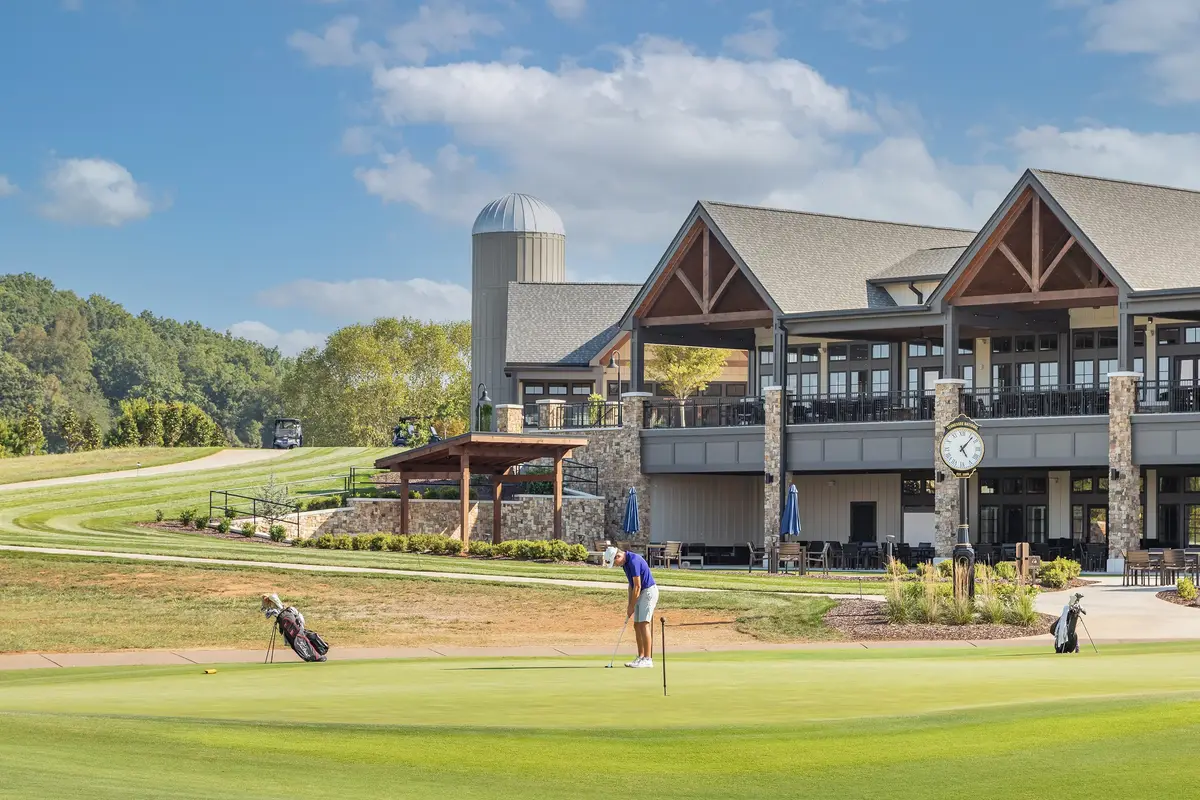
The championship course at Tennessee National was designed to take advantage of every feature the property offers — lakefront exposure, mountain sightlines, elevation changes, and mature hardwood corridors.
The front nine introduces the lake gradually, with holes that move from interior wooded corridors toward the shoreline. By the mid-round turn, you’re playing along the water with the mountains stacking up behind every green.
The back nine pushes into higher terrain, delivering the elevation-based views and strategic downhill shots that make East Tennessee courses special. The finishing holes bring you back toward the clubhouse with a closing stretch that combines everything — water, elevation, trees, and the kind of natural amphitheater setting that makes the 18th hole feel like an event.
It’s a course built for golfers who care about the game and the experience. The two aren’t separate here. They’re the same thing.
Playing Year-Round
Unlike mountain courses in the Carolinas or Virginia that close for winter, East Tennessee’s climate supports 12-month golf. Average winter highs in Loudon County sit in the upper 40s to low 50s. That’s jacket weather, not closing-the-course weather.
Tennessee National members play through every season, and many will tell you the winter rounds — fewer players, sharper views, perfect turf conditions — are the best-kept secret in the Southeast.
The Bottom Line
You can find good golf in a lot of places. But the combination of mountain panoramas, lakefront holes, year-round playability, and a course designed around the natural terrain? That’s a short list. East Tennessee is on it. Tennessee National is at the top.
Come play a round. The views will make the case better than any article can.